
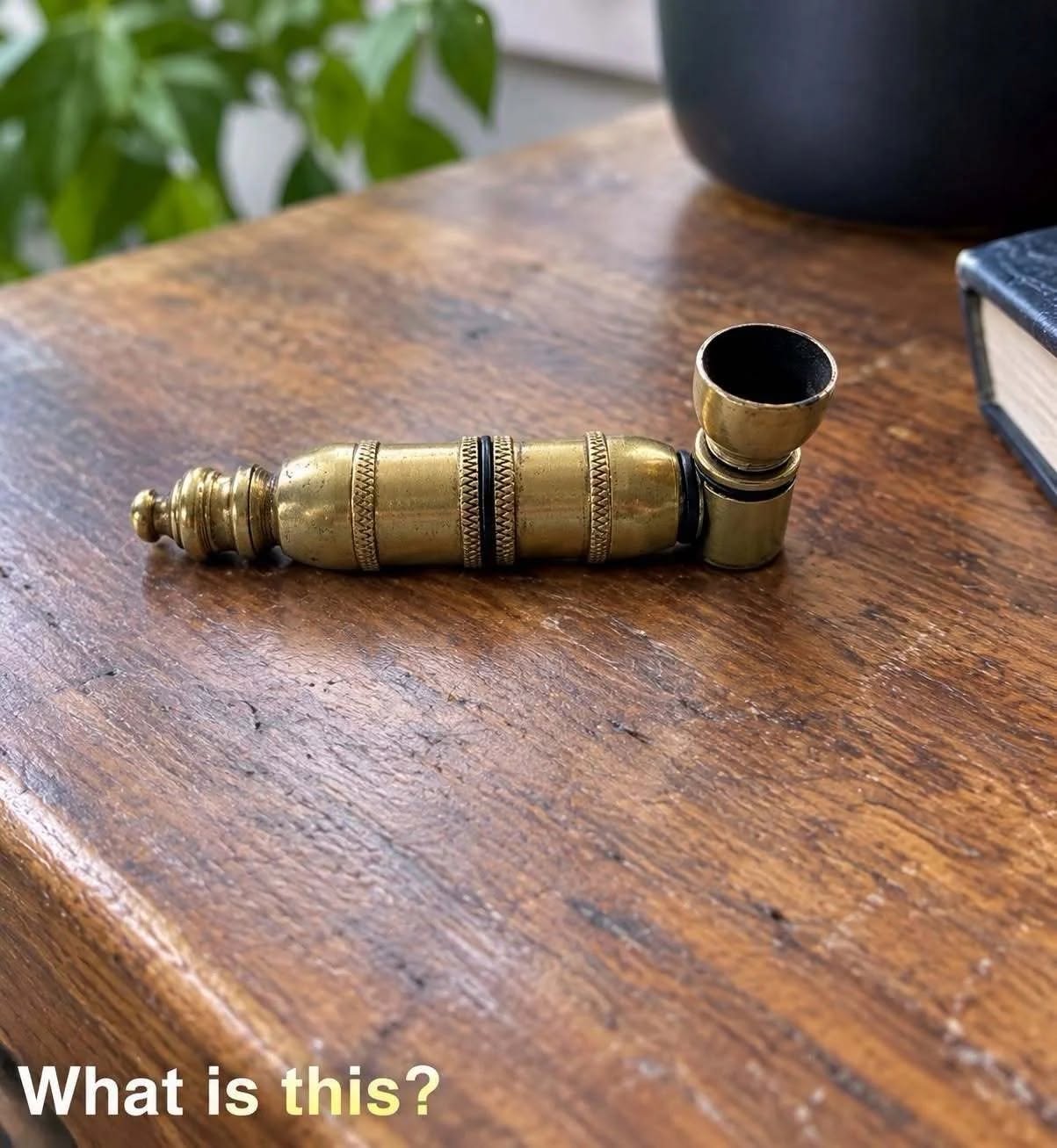
Its value may be in its craftsmanship and history rather than its original function.
Why Old Brass Objects Can Be So Interesting
Objects like this provide a small glimpse into everyday life from another period.
Today, most people encounter highly standardized manufactured products. Older personal objects were often much more distinctive.
A person’s belongings might include:
A pocket knife
A tobacco pouch
A pipe
A match holder
A pocket watch
A snuff box
A small brass container
A decorated lighter
A personal grooming tool
Some were inexpensive everyday objects. Others were carefully decorated and treated almost like jewelry.
A tiny brass smoking pipe could therefore have been both functional and personal.
That makes the story behind a family example potentially more interesting than its monetary value.
What Would Confirm the Identification?
The best next step would be to photograph the object from several additional angles.
In particular, look for:
1. A hole through the body
If there is a continuous airway from the bowl toward the opposite end, that strongly supports the pipe identification.
2. A removable section
If part of the object unscrews, the internal construction could reveal how it was intended to work.
3. Maker’s marks
Even a tiny engraving can be valuable.
4. Country markings
Words such as “India,” “Japan,” “England,” or another country could narrow down its origin.
5. Exact measurements
Length, diameter, bowl size, and weight can help distinguish similar objects.
6. Interior residue
The interior may show evidence of previous use, although it should not be handled unnecessarily.
The Most Likely Answer
So, what did Grandpa’s mysterious brass object turn out to be?
The strongest identification from this photograph is a small vintage brass smoking pipe or portable smoking accessory.
Its bowl-like opening, compact tubular body, apparent airway, and decorative brass construction all support that explanation.
It may have been intended for tobacco, or it may have belonged to another smoking tradition, but there isn’t enough visual evidence to confidently assign it to one specific substance or historical culture.
The exact age is also uncertain.
What makes it fascinating is the craftsmanship. The maker clearly didn’t need to decorate a simple functional object with multiple engraved and textured rings, yet someone went to the trouble of doing exactly that.
That suggests the little object may have been valued not only for what it did, but also for how it looked.
And if it really spent decades inside a grandfather’s drawer, its greatest value may not be its price at all.
It may simply be a small surviving piece of someone’s everyday life—a personal object that was handled, carried, stored, and eventually forgotten until someone opened that dusty drawer many years later.
