
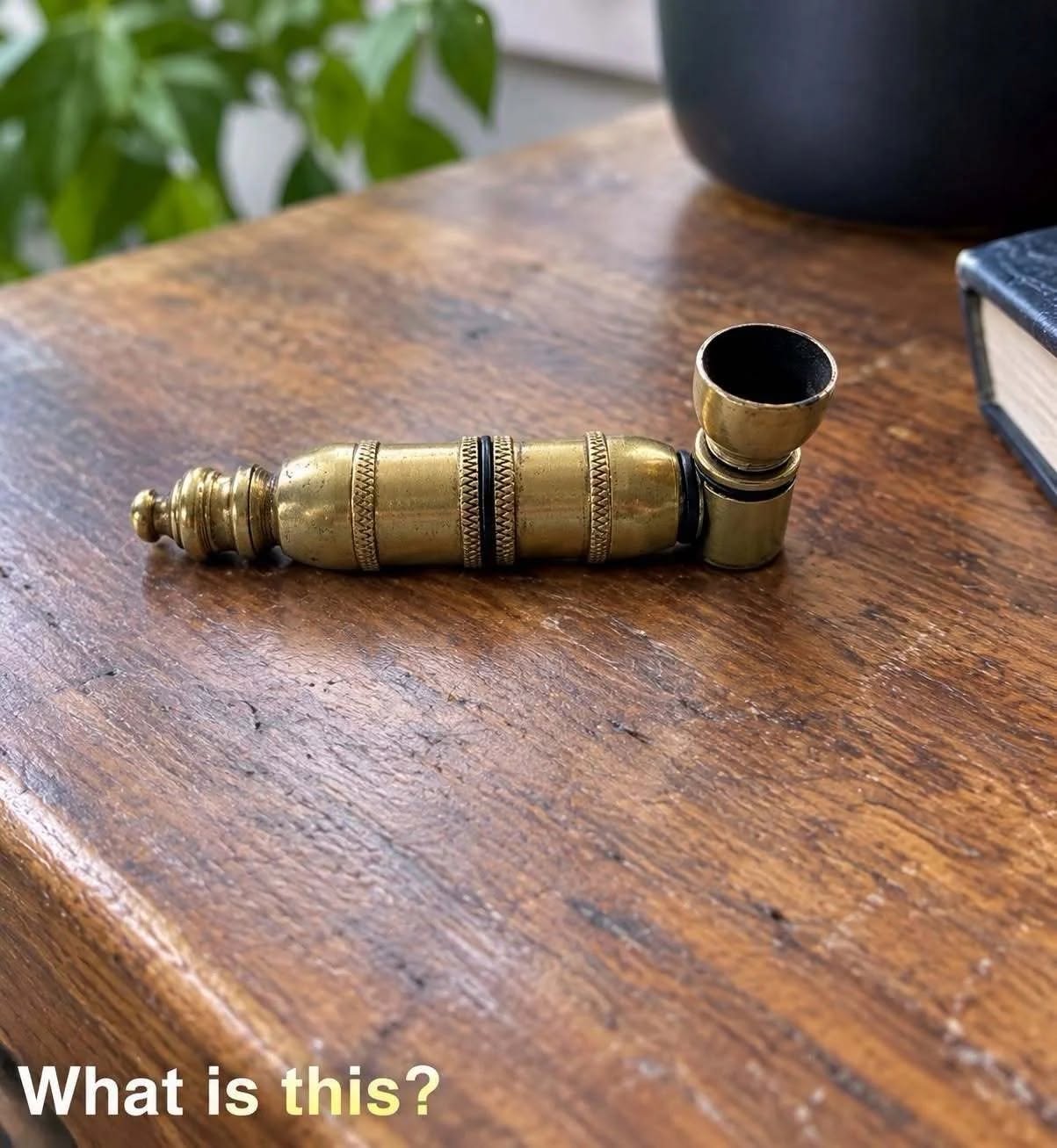
At first glance, this little brass object looks almost like a miniature piece of antique machinery. Its ornate rings, aged golden surface, compact size, and unusual shape make it easy to understand why someone might find it in a grandfather’s drawer and have absolutely no idea what it was used for.
Based on the shape shown in the photograph, the most likely explanation is that this is a small vintage smoking pipe, probably a portable brass pipe or pipe-style smoking accessory.
The exact origin and age cannot be established from one photograph alone, but several features strongly point toward that purpose.
The Shape Gives Away Its Original Purpose
The most obvious clue is the small cup-shaped bowl at one end.
That rounded opening is characteristic of a smoking pipe. The material would have been placed in the bowl, while the opposite end functioned as the mouthpiece.
The object is also extremely compact. Rather than looking like a conventional large tobacco pipe, it appears to have been designed as a small, portable smoking instrument.
Vintage brass pipes were produced in many forms. Some were simple and utilitarian, while others were deliberately decorated with turned brass rings, grooves, beads, and ornamental sections.
The elaborate appearance of this example suggests that it may have been intended to be more than an ordinary everyday object. Small smoking accessories were sometimes made as decorative pieces, souvenirs, personal possessions, or collector’s items.
Why Is It Made of Brass?
Brass was historically a very useful material for small household and personal objects.
It is an alloy primarily made from copper and zinc, and it can be cast, turned, engraved, polished, and decorated relatively easily.
That made it attractive to craftsmen producing:
- Smoking accessories
- Snuff boxes
- Pipe fittings
- Small containers
- Decorative objects
- Pocket accessories
- Mechanical components
- Household ornaments
Brass also develops a distinctive patina as it ages.
A newly polished brass object can have a bright golden appearance, while an older example may become darker, duller, or develop areas of brown, green, or black oxidation.
The object in the photograph has exactly the kind of aged appearance that makes old brass collectibles so interesting.
The Decorative Rings Are an Important Clue
Look closely at the central body.
There are several raised and patterned rings surrounding the brass cylinder. They aren’t necessary for a simple mechanical function, so they appear to serve an aesthetic purpose as well as possibly providing grip.
This kind of decorative turning is common in older metalwork.
Instead of being manufactured as a plain tube, the maker shaped the brass into several sections, creating alternating smooth and textured areas.
That gives the object a surprisingly sophisticated appearance considering how small it is.
The decoration also suggests that the object may have been intended to be carried or displayed as a personal possession rather than simply hidden away as an anonymous tool.
Is It an Antique Pipe?
Possibly—but “antique” should be used carefully.
The photograph certainly shows an object with an old-fashioned appearance, but appearance alone cannot establish its date.
A brass pipe made 100 years ago can look similar to a decorative pipe manufactured several decades later.
Some vintage brass smoking objects were made in the 19th century and early 20th century. Others were produced much later and deliberately designed to look old.
The best clues for determining its age would be:
- Maker’s marks
- Engravings
- Stamps
- Country-of-origin markings
- Construction techniques
- Type of brass
- Wear patterns
- Patina
- Soldering or joining methods
- Threads and fittings
- Provenance
If the object really came from a grandfather’s collection, its history could be especially interesting.
A photograph of the opposite side, the underside, and the ends could reveal additional information.
Could It Be a Tobacco Pipe?
Yes.
A traditional smoking pipe generally has two basic functional areas: a place where the smoking material was held and an airway leading toward the mouthpiece.
The object shown appears consistent with that general concept.
However, because the design is unusual and compact, it would be inaccurate to say with certainty exactly what material was originally smoked in it.
Older small pipes were used for various forms of smoking, and similar-looking objects have been described as tobacco pipes, pocket pipes, water-pipe components, or other smoking accessories.
The visual evidence is strong enough to identify the general category, but not strong enough to determine the precise historical use.
Why Would Someone Own Such a Tiny Pipe?
Portability is probably the biggest explanation.
A large traditional tobacco pipe isn’t particularly convenient to carry around.
A tiny metal pipe could be kept in:
A pocket
A drawer
A small box
A tobacco pouch
A travel case
A personal collection
The brass construction would also make it relatively durable compared with fragile ceramic or clay.
This may explain why an object like this could survive for decades while remaining almost completely intact.
The small size also explains why it might have been stored in a drawer rather than displayed openly.
Could It Be a Miniature or Decorative Object?
That’s another possibility worth considering.
Some vintage manufacturers produced miniature versions of everyday objects as curiosities or decorative pieces.
However, this particular object appears to have functional features rather than simply being a miniature sculpture.
The bowl-like opening and apparent airway strongly support the smoking-pipe interpretation.
That said, it could have been used primarily as a decorative collectible rather than actively smoked.
Old smoking accessories were sometimes collected because of their craftsmanship, unusual shapes, materials, or cultural history.
The Mystery of the Black Rings
One particularly interesting feature is the dark material visible between some of the brass sections.
These areas could potentially be:
A darker metal component
An aged or oxidized surface
A gasket or seal
A decorative insert
Residue from previous use
Another material incorporated into the construction
It is difficult to determine which from the photograph alone.
If the dark sections are flexible rather than metallic, that would be an especially useful clue.
If they are rigid metal rings, the object may have been constructed differently from a simple one-piece pipe.
This is one reason why photographs from several angles are useful when identifying vintage objects.
Could It Be a Water Pipe?
Possibly, although the photograph alone doesn’t establish that.
Some small vintage brass smoking devices were designed with chambers or reservoirs that could function differently from an ordinary straight pipe.
The important thing is not to assume that every unusual brass pipe is automatically an antique “opium pipe,” “hash pipe,” or another specific type.
Those labels are often applied too quickly to mysterious vintage objects online.
Historical smoking equipment came in many forms, and similar designs could be used for different purposes in different regions.
Without documentation or additional construction details, the safest identification is simply:
a small vintage brass smoking pipe or smoking accessory.
The Object May Be More Recent Than It Looks
This is something collectors frequently encounter.
Brass naturally develops an aged appearance, and manufacturers have been making intentionally vintage-looking brass objects for generations.
A newer object can therefore look surprisingly old.
Signs that could help distinguish an older piece from a modern reproduction include:
Hand finishing
Older objects may show irregularities from manual finishing, filing, or turning.
Wear
Repeated handling can produce smoother areas where fingers regularly touched the object.
Natural oxidation may be uneven rather than perfectly uniform.
Threads
The style and precision of threads can sometimes provide clues about manufacturing technology.
Marks
A maker’s stamp can be one of the most valuable clues.
How individual components were joined can reveal whether an object was handmade, machine-produced, or assembled from modern parts.
Don’t Polish It Immediately
If this really came from a family collection, one of the worst things to do immediately is aggressively polish it.
Collectors often value original patina.
A heavily polished object may look shiny and new, but the process can remove surface characteristics that help establish its age and history.
Before cleaning anything, photograph it carefully.
Both sides
The bowl
The mouthpiece
The underside
Any markings
The interior
The joints
The decorative rings
If there are inscriptions or stamps, photograph them close up.
Even a tiny symbol can sometimes identify a manufacturer or country.
What If You Want to Handle It?
If the object has been sitting in a dusty drawer for many years, ordinary precautions are sensible.
Wear gloves if the surface is dirty or corroded, especially before cleaning it.
Wash your hands afterward.
Do not put the object in your mouth simply to test whether it is functional.
Old metal objects can contain accumulated residue, corrosion products, dirt, or unknown substances from previous use.
And if you are interested in preserving it as a historical collectible, there is little reason to actually use it.
 Continued on the next page
