
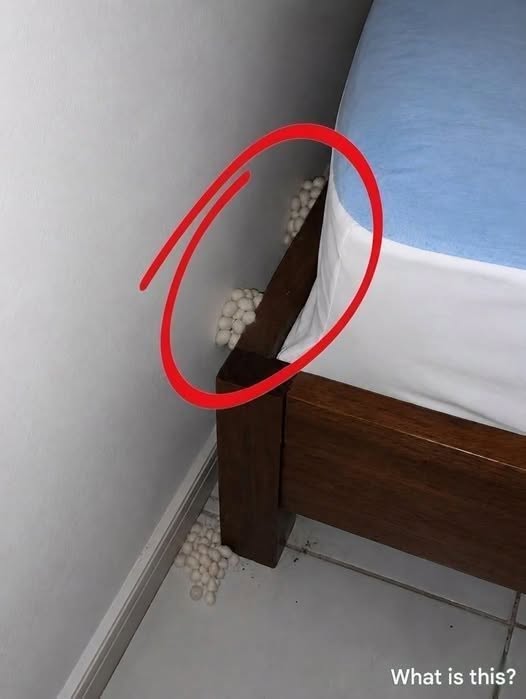
Coming home after a long day and discovering dozens of strange white objects behind your bed would be enough to surprise anyone. In this photo, small, pale, rounded objects are clustered in the narrow gap between a wall and a wooden bed frame, with more scattered across the floor.
But what are they? Could they be insect eggs, something left by an animal, or simply household debris?
The answer depends on their size, texture, and how they got there. A photograph alone is not enough to identify them with certainty.
1. Could They Be Insect Eggs?
One possibility worth investigating is that the objects are related to an insect or another small animal. However, different species lay eggs with very different shapes and appearances.
For example, bed bug eggs are typically tiny, pearly white, and oval-shaped, measuring about 1 millimeter long. They are commonly found attached to surfaces in mattress seams and furniture crevices.
The objects in this photograph appear more rounded and substantially larger than typical bed bug eggs, so identifying them as bed bug eggs based on appearance alone would be misleading.
2. Could They Be Eggs From Another Animal?
Some insects, spiders, and other small animals leave eggs or egg masses in sheltered places. Nevertheless, many species produce eggs that are attached to surfaces, enclosed in protective cases, or surrounded by a soft or gelatinous material.
A cluster of round white objects is not enough to determine which animal, if any, produced them.
Looking for nearby insects, webs, damaged wood, or other physical evidence may help narrow down the possibilities.
3. Could They Be Household Materials?
Another possibility is that the objects are not biological at all.
Small plastic or foam beads, packing materials, and other manufactured particles can collect in narrow spaces around furniture. If the objects are unusually uniform in size and shape, this possibility is worth considering.
Their texture and firmness can provide useful clues, although appearance alone may still be inconclusive.
4. What Should You Do If You Find Something Similar?
⏬Continued ⏬on the ⏬next ⏬page
